Sunday, March 31, 2019

D-Street Buzz: Media stocks crack led by Zee Entertainment; REC spikes 10%

The Indian benchmark indices have extended the early morning losses and are trading deep in the red with Nifty down 123 points, trading at 11,333 whereas Sensex has fallen 417 points, trading at 37,746.

Nifty Realty was the top loser, down over 2 percent dragged by Indiabulls Real Estate, DLF, Prestige Estate, Sunteck Realty and Unitech.

Media stocks are also down with the index shedding 2 percent led by DEN Networks which is down 4 percent followed by Zee Entertainment, Zee Media, Dish TV, PVR, Sun TV Network and DB Corp.

From the auto space, the top losers are Ashok Leyland, Exide Industries, Motherson Sumi Systems, Tata Motors, Mahindra & Mahindra and Hero MotoCorp.

related news Jet Airways surges 15% on report of resignation of Naresh Goyal & Anita Goyal Over 100 stocks hit 52-week low; realty, telecom & metal stocks biggest losers Hero Motocorp touches 52-week low, sheds over 7% in 9 sessions

Selective FMCG stocks are down with losses from United Breweries, United Spirits, Colgate Palmolive and Marico.

From the BSE midcap space, the top losers are Edelweiss Financial, IIFL Holdings, SAIL, PNB Housing Finance, United Breweries and Indian Bank while from the smallcap space, the top losers are ZEN Tech, Mukand, Dish TV and Bombay Dyeing among others.

Banks continue to remain weak with loses from ICICI Bank and Kotak Mahindra Bank that shed 2 percent each followed by YES Bank, PNB, State Bank of India, Axis Bank and Bank of Baroda.

The top Nifty gainers include IOC, NTPC, ONGC, Power Grid and HPCL while the top losers included Zee Entertainment, Vedanta, UPL, Bharti Infratel and Sun Pharma.

The most active stocks are Reliance Industries, REC, Maruti Suzuki, Just Dial and HDFC.

Arvind Fashions, Spacenet Enterprises, Jai Balaji Industries, Info Edge, REC and Bil Energy Systems have hit 52-week high on NSE while Hero Moto, Alkem Laboratories, Igarashi Motors, Lakshmi Energy, Simplex Projects and Genesys International have hit 52-week low.

The breadth of the market favoured the declines with 360 stocks advancing and 1,348 declining while 394 remained unchanged. On the BSE, 664 stocks advanced, 1,813 declined and 148 remained unchanged.

Disclosure: Reliance Industries Ltd. is the sole beneficiary of Independent Media Trust which controls Network18 Media & Investments Ltd. First Published on Mar 25, 2019 01:40 pm

Sunday, March 24, 2019

Buy Domino's Pizza For Fantastic Total Return And Steady Growth

This article is about Domino's Pizza (DPZ) and why it's a great buy for the total return investor that also wants some dividend income. Domino's Pizza is one of the largest fast food companies in the United States and foreign countries.

Domino's Pizza will be evaluated using The Good Business Portfolio guidelines, my IRA portfolio of good business companies that are balanced among all styles of investing. The company has steady growth and has cash it uses to increase the dividends each year and open new stores.

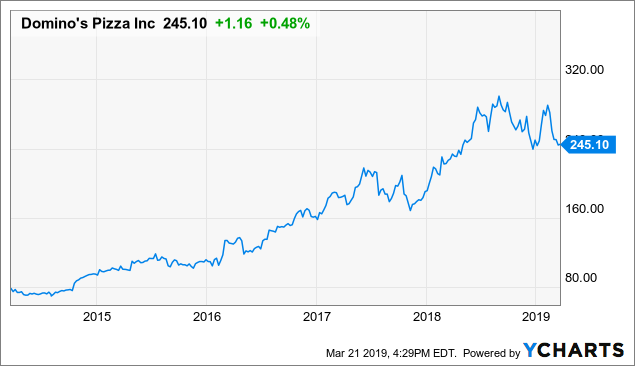
When I scanned the five-year chart, Domino's Pizza has a good chart going up and to the right on a strong upslope from 2015 through to date. This is the kind of chart I like showing the defensive nature of their business with straight line growth.

Chart Data by YCharts

Fundamentals of Domino's Pizza will be reviewed on the following topics below.

The Good Business Portfolio Guidelines Total Return and Yearly Dividend Last Quarter's Earnings Company Business Takeaways Recent Portfolio Changes

I use a set of guidelines that I codified over the last few years to review the companies in The Good Business Portfolio (my portfolio) and other companies that I am reviewing. For a complete set of the guidelines, please see my article " The Good Business Portfolio: Update to Guidelines, August 2018". These guidelines provide me with a balanced portfolio of income, defensive, total return and growing companies that hopefully keeps me ahead of the Dow average.

Good Business Portfolio Guidelines

Domino's Pizza International passes 10 of 11 Good Business Portfolio Guidelines, a good score (a good score is 10 or 11). These guidelines are only used to filter companies to be considered in the portfolio. Some of the points brought out by the guidelines are shown below.

Domino's Pizza does not meet my dividend guideline of having dividends increase for 8 of the last ten years and having a minimum of 1% yield, with seven years of increasing dividends and a 1.1% yield. Domino's Pizza is, therefore, a good choice for the dividend income investor because the dividend growth is 22% over the past 5 years and next year should easily pass this guideline. The three-year average payout ratio is low at 25%. After paying the dividend, this leaves plenty of cash remaining for increasing the business by opening new stores. I have a capitalization guideline where the capitalization must be greater than $10 Billion. DPZ passes this guideline. DPZ is a mid-cap company with a capitalization of $10.1 Billion. Domino's Pizza 2019 projected cash flow at $400 Million is good allowing the company to have the means for company growth and increased dividends. I also require the CAGR going forward to be able to cover my yearly expenses and my RMD with a CAGR of 7%. My dividends provide 3.3% of the portfolio as income, and I need 1.9% more for a yearly distribution of 5.2% plus an inflation cushion of 1.8%. The three-year forward CAGR of 17% meets my guideline requirement. This good future growth for Domino's Pizza can continue its uptrend benefiting from the continued growth in the worldwide economy. My total return guideline is that total return must be greater than the Dow's total return over my test period. DPZ passes this guideline since their total return is 153.85%, much more than the Dow's total return of 44.04%. Looking back five years, $10,000 invested five years ago would now be worth over $32,400 today. This makes Domino's Pizza a good investment for the total return investor looking back, that has future growth as the economy continues to grow. One of my guidelines is that the S&P rating must be three stars or better. DPZ's S&P CFRA rating is three stars or hold with a target price to $275, passing the guideline. DPZ's price is presently 12% below the target. DPZ is under the target price at present and has a high PE of 25, making DPZ a fair buy at this entry point for the long term growth investor that wants good steady increasing dividends and future total return growth. One of my guidelines is would I buy the whole company if I could. The answer is yes. The total return is great, and the below average growing dividend makes DPZ a good business to own for income and growth. The Good Business Portfolio likes to embrace all kinds of investment styles but concentrates on buying businesses that can be understood, makes a fair profit, invests profits back into the business and also generates a good income stream. Most of all what makes DPZ interesting is the potential long-term growth of their business as the working population and the worldwide economy increases. Total Return and Yearly Dividend

The Good Business Portfolio Guidelines are just a screen to start with and not absolute rules. When I look at a company, the total return is a key parameter to see if it fits the objective of the Good Business Portfolio. Domino's Pizza passes this total return guideline against the Dow baseline in my 51-month test. I chose the 51 month test period (starting January 1, 2015, and ending to date) because it includes the great year of 2017, and other years that had fair and bad performance. The good total return of 153.85% makes Domino's Pizza a great investment for the total return investor that also wants a steadily increasing income. DPZ has a below average dividend yield of 1.1% and has had increases for seven years making DPZ also a fair choice for the dividend investor. The Dividend was increased February 2019 to $0.65/Qtr. from $0.55/Qtr. or an 18% increase.

DOW's 51 Month total return baseline is 44.04%

Company Name

51 Month total return

The difference from DOW baseline

Yearly Dividend percentage

Domino's Pizza

153.85%

+109.81%

1.1%

Click to enlarge

Last Quarter's Earnings

For the last quarter on February 21, 2019, Domino's Pizza reported earnings that missed expected by $0.07 at $2.62 and compared to last year at $2.09. Total revenue was higher at $1.09 Billion up more than a year ago by 21.38% year over year and missed expected revenue by $7.9 Million. This was a mixed report with the bottom line increasing over last year but missing expected earnings and the top line increasing. The next earnings report will be out late May 2019 and is expected to be $2.14 compared to last year at $2.00.

Business Overview

Domino's Pizza is one of the largest fast food companies in the United States and foreign countries.

As per excerpts from Reuters

Domino's Pizza is a pizza restaurant chain company. As of January 1, 2017, the Company operated in over 13,800 locations in over 85 markets around the world.

The Company operates through three segments: domestic stores, an international franchise, and supply chain. Its basic menu features pizza products in various sizes and crust types. Its stores also offer oven-baked sandwiches, pasta, boneless chicken and wings, bread side items, desserts, and soft drink products.

International markets vary toppings by country and culture, such as squid toppings in Japan or spicy cheese in India, and feature regional specialty items, such as a banana and cinnamon dessert pizza in Brazil."

Overall Domino's Pizza is a good business with 17% CAGR projected growth as the United States and foreign economies grow going forward, with the increasing demand for DPZ's fast food. The below average dividend income brings you cash as we continue to see further growth as the world economy grows.

The FED has kept interest rates low for some years, and on December 19, 2018, they raised the base rate of 0.25%, which was expected. I believe that they will go slow in 2019, which should help keep the economy on a growth path. If infrastructure spending can be increased, this will even increase the United States growth going forward with better economics for the consumer. At the March 20 meeting, the FED lowered United States GDP projection for 2019 which may mean they are getting to neutral on the economy, projecting no rate increases for 2019. The FED meeting Statement was a wait and see and a bit more dovish than the last meeting.

From February 21, 2019, earnings call Rich Allison (Chief Executive Officer and President) said

I'm pleased with what was a terrific fourth quarter, one that capped another outstanding year for Domino's. Our results continue to outpace the industry and our franchisees across the globe continue to make me extremely proud.

Retail sales growth matters, and once again we delivered. Our global retail sales growth reflected a strong balance, across our US and international businesses. For both businesses in Q4, our growth reflected a healthy blend of unit growth and traffic driven same-store sales. Looking first at our US business, double-digit retail sales growth in Q4 was comprised of a very healthy and order count driven 5.6% comp and 125 net new units.

Turning now to International, we delivered strong retail sales growth for the fourth quarter and a double-digit result for the whole year. Fourth quarter net unit openings were particularly strong and represented a significant acceleration over previous quarters. Same-store sales performance can certainly improve versus what we have all come to expect, but I'm pleased to see all of our comp coming from order growth.

During the quarter, we had two important milestones. First, we opened our 10,000 stores outside of the United States, a testament to the unit growth engine, this segment has provided to the business over a lengthy period of time. In addition, the fourth quarter was officially our 100th consecutive quarter of positive same-store sales growth. To think that we have grown sales in our international business for 25 straight years, and 100 straight quarters, still honestly blows my mind. And is a testament to us having the best international model in QSR."

This shows the feelings of top management for the continued growth of the Domino's Pizza business and shareholder return with an increase in future growth. DPZ has good growth and will continue as the foreign economies grow and demand for fast food increases. Domino opened 1058 new stores in 2018 with expectations of more to come in 2019.

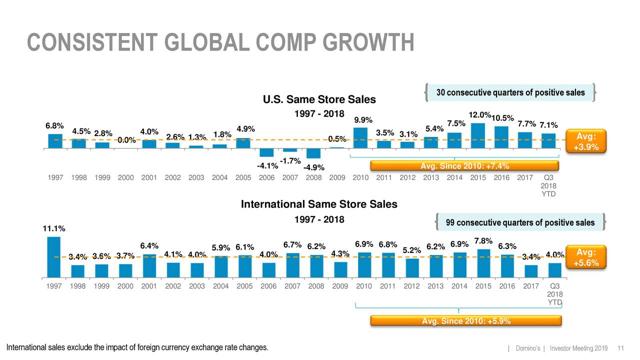
The graphic below shows the global growth of Domino's Pizza over the years with increasing sales almost every year as stated by the CEO.

The fourth quarter marked our 31st consecutive quarter of positive US same-store sales growth and capped very strong top-line performance in 2018, above our three to five-year outlook range. And continually driven by focus, fundamentals, and execution. I'm so proud of our US franchisees and teams who continue to lead the Domino's system."

Source: March 8, 2019, Investment Conference Slides

Takeaways

Domino's Pizza is a great investment choice for the total return investor with it's above DOW average total return and the dividend growth investor for income. Domino's Pizza will be considered for The Good Business Portfolio as an addition to the McDonalds (MCD) position since they sell different products. If you want a growing dividend income and great total return in the fast food business, DPZ may be the right investment for you.

Recent Portfolio Changes

I intend to watch the earnings reports for the companies in the portfolio and may finally decide to trim my high flyers that are over 8% of the portfolio so I can invest in good companies on my buy list.

On March 13 increased position of Realty Income Corp. (O) to 0.85% of the portfolio, I could use a bit more steady monthly income. On March 12 the portfolio closed out the position of Arconic (ARNC) , I only have one more commodity play Freeport McMoRan (FCX) that I think will go up over time. On March 11 the portfolio reduced the position of Arconic (ARNC) from 0.4% of the portfolio to 0.3%. I will sell the rest of this position within the month. The dividend was just cut, and forward growth is under-par. On March 7 added to position of Simulation Plus (SLP) from 0.33% of the portfolio to 0.45%. I will add slowly to this position as available cash allows. On March 4, trimmed position of Hewlett Packard (HPQ) from 1.3% of the portfolio to 1.0%. The last earnings report was poor, and future growth looks weak at 2%, time to sell HPQ for a better business. On February 28, trimmed position of Boeing (BA) from 16.1% of the portfolio to 15.8%. I love Boeing, but you have to have diversification. On February 2 increased position of Realty Income Corp. to 0.7% of the portfolio, I could use a bit more steady monthly income. On January 30 increased the position of Simulations Plus from 0.2% of the portfolio to 0.4%. I think their product may be the product of the future for drug testing. On January 28 Bought a starter position of Realty Income Corp., I could use a bit more steady income and hope to add to this holding in the future. Realty Income Corp. is now 0.4% of the portfolio. On January 28 sold the remaining portion of Mondelez (MDLZ). The forward growth does not look good enough. On January 24 increased the position of Digital Reality Investors (DLR) from 3.1% of the portfolio to 3.6%. I want to get DLR up to a full position of 4%. On January 16 sold the remaining shares of 3M (MMM). I decided to sell this small position in order to reduce the number of positions with a new target number of 20 positions max from 25. On January 11 started a new position in Lockheed (LMT) at 0.65% of the portfolio.

The Good Business Portfolio trims a position when it gets above 8% of the portfolio. The five top percentage of the portfolio companies in the portfolio are, Johnson & Johnson (JNJ) is 8.3% of the portfolio, Eaton Vance Enhanced Equity Income Fund II is 8.0% of the portfolio, Home Depot (HD) is 8.8% of the portfolio, Omega Health Investors (OHI) and Boeing (BA) is 14.8% of the portfolio. Therefore BA, EOS, JNJ, OHI, and Home Depot are now in trim position, but I am letting them run a bit since they are great companies.

Boeing is going to be pressed to 15% of the portfolio because of it being cash positive on 787 deferred plane costs at $316 Million in the first quarter of 2017, an increase from the fourth quarter. The first quarter earnings for 2018 were unbelievable at $3.64 compared too expected at $2.64. Farnborough Air Show sales in dollar value just beat out Air-Bus by about $6 Billion, and both companies had a great number of orders. Boeing received an order for 18 more KC-46A planes. The second quarter 2018 earnings beat expectations by $0.06 at $3.33, but a good report was hurt by a write off expense on the KC-46 which has started delivery in 2019. Two KC-46A tankers were delivered in January 2019. As a result of the good fourth-quarter earnings, S&P CFRA raised the one-year price target to $500 for a possible 20% upside potential. Boeing has dropped in the last 2 weeks because of the second 737 Max-8 crash, and I look at this as an opportunity to buy BA at a reasonable price. This is just my opinion.

JNJ will be pressed to 9% of the portfolio because of its defensive nature in this post-BREXIT world. Earnings in the last quarter beat on the top and bottom line and Mr. Market did nothing. JNJ has an estimated dividend increase to $0.97/Qtr. in April 2019, which will be 57 years in a row of increases. JNJ is not a trading stock but a hold forever; it is now a strong buy as the healthcare sector remains under pressure.

For the total Good Business Portfolio, please see my article on The Good Business Portfolio: 2018 4 th Quarter Earnings and Performance Review for the complete portfolio list and performance. Become a real-time follower, and you will get each quarter's performance after the next earnings season is over.

Disclosure: I am/we are long BA, JNJ, HD, OHI, MO, IR, DLR, GE, PM, IR, EOS, TXN, ADP, FCX, MCD, O. I wrote this article myself, and it expresses my own opinions. I am not receiving compensation for it (other than from Seeking Alpha). I have no business relationship with any company whose stock is mentioned in this article.

Additional disclosure: Of course, this is not a recommendation to buy or sell, and you should always do your own research and talk to your financial advisor before any purchase or sale. This is how I manage my IRA retirement account, and the opinions of the companies are my own.

Friday, March 22, 2019

SLM Corp (SLM) Short Interest Update

SLM Corp (NASDAQ:SLM) was the recipient of a significant drop in short interest in February. As of February 28th, there was short interest totalling 25,344,682 shares, a drop of 7.9% from the February 15th total of 27,526,633 shares. Based on an average daily volume of 2,432,026 shares, the days-to-cover ratio is presently 10.4 days. Approximately 5.9% of the company’s stock are sold short.

A number of research analysts have recently commented on the stock. ValuEngine downgraded shares of SLM from a “hold” rating to a “sell” rating in a research report on Tuesday, March 5th. TheStreet raised shares of SLM from a “c+” rating to a “b-” rating in a research report on Monday, January 28th. Wedbush reissued an “outperform” rating on shares of SLM in a research report on Tuesday, January 29th. BMO Capital Markets upgraded SLM from a “market perform” rating to an “outperform” rating in a report on Friday, January 25th. Finally, BidaskClub cut SLM from a “hold” rating to a “sell” rating in a report on Wednesday. Two research analysts have rated the stock with a sell rating and seven have given a buy rating to the company. The stock currently has a consensus rating of “Buy” and an average target price of $13.18.

Get SLM alerts:

In related news, SVP Jonathan Boyles sold 68,000 shares of the firm’s stock in a transaction on Friday, March 1st. The shares were sold at an average price of $11.20, for a total value of $761,600.00. Following the completion of the transaction, the senior vice president now directly owns 67,679 shares of the company’s stock, valued at $758,004.80. The transaction was disclosed in a document filed with the Securities & Exchange Commission, which is available through this link. Also, EVP Paul F. Thome sold 25,000 shares of the firm’s stock in a transaction on Wednesday, February 27th. The shares were sold at an average price of $11.10, for a total transaction of $277,500.00. Following the completion of the transaction, the executive vice president now directly owns 208,049 shares of the company’s stock, valued at $2,309,343.90. The disclosure for this sale can be found here. Over the last 90 days, insiders sold 93,805 shares of company stock valued at $1,047,625. Corporate insiders own 0.36% of the company’s stock.

Several hedge funds have recently made changes to their positions in SLM. Norges Bank bought a new stake in shares of SLM during the 4th quarter worth about $22,405,000. Bayview Asset Management LLC bought a new stake in shares of SLM during the fourth quarter worth approximately $20,475,000. CI Investments Inc. boosted its holdings in shares of SLM by 33.8% during the fourth quarter. CI Investments Inc. now owns 9,058,926 shares of the credit services provider’s stock worth $75,280,000 after acquiring an additional 2,289,626 shares during the period. BlackRock Inc. boosted its holdings in shares of SLM by 4.4% during the fourth quarter. BlackRock Inc. now owns 43,240,757 shares of the credit services provider’s stock worth $359,332,000 after acquiring an additional 1,823,633 shares during the period. Finally, Portolan Capital Management LLC boosted its holdings in shares of SLM by 80.3% during the fourth quarter. Portolan Capital Management LLC now owns 3,875,937 shares of the credit services provider’s stock worth $32,209,000 after acquiring an additional 1,726,393 shares during the period.

SLM stock opened at $10.53 on Friday. The company has a debt-to-equity ratio of 1.67, a current ratio of 1.38 and a quick ratio of 0.21. SLM has a one year low of $7.95 and a one year high of $12.46. The firm has a market cap of $4.63 billion, a price-to-earnings ratio of 9.84, a P/E/G ratio of 0.43 and a beta of 1.50.

SLM (NASDAQ:SLM) last released its quarterly earnings data on Wednesday, January 23rd. The credit services provider reported $0.31 EPS for the quarter, topping the Zacks’ consensus estimate of $0.27 by $0.04. SLM had a net margin of 26.07% and a return on equity of 20.05%. The firm had revenue of $382.87 million during the quarter, compared to analysts’ expectations of $367.40 million. During the same period in the previous year, the business posted $0.19 earnings per share. The company’s revenue for the quarter was up 23.8% compared to the same quarter last year. As a group, sell-side analysts anticipate that SLM will post 1.25 earnings per share for the current fiscal year.

The business also recently announced a quarterly dividend, which was paid on Friday, March 15th. Investors of record on Tuesday, March 5th were issued a dividend of $0.03 per share. This represents a $0.12 annualized dividend and a dividend yield of 1.14%. The ex-dividend date was Monday, March 4th. SLM’s payout ratio is 11.21%.

COPYRIGHT VIOLATION NOTICE: This piece of content was originally posted by Ticker Report and is the sole property of of Ticker Report. If you are reading this piece of content on another domain, it was stolen and republished in violation of United States & international trademark & copyright law. The legal version of this piece of content can be read at https://www.tickerreport.com/banking-finance/4224856/slm-corp-slm-short-interest-update.html.

About SLM

SLM Corp. engages in the origination, servicing, and administration of education loans. Its services include private education loans, banking, college savings, and insurance services. The company was founded in 1972 and is headquartered in Newark, DE.

Read More: What is intrinsic value?

Monday, March 18, 2019

Top 10 Tech Stocks For 2019

tags:CCRN,GRVY,MODN,AVGO,KONE,IPGP,AMSWA,CYRN,PCLN,INXN,

European aircraft maker Airbus reported first-quarter results Friday morning, and the report was dominated by the company’s continuing problem: getting enough engines to deliver new A320neos to customers. The company’s revenues for the first quarter of the year totaled €10.1 billion (about $12.2 billion), down from €11.4 billion last year.

Airbus reported net new orders for 45 commercial jets, a big improvement from just six in the year-ago quarter. The orders include one for 20 A380 superjumbo passenger jets from Emirates. The company delivered 121 commercial jets in the quarter, compared to 136 deliveries in the year-ago quarter.

Adjusted consolidated EBIT in the first quarter totaled €14 million, compared to a net loss of €19 million last year. Adjusted EBIT for the commercial jet business showed a net loss of €41 million, which reflects the company’s inability to deliver A320neos.

Engine-maker Pratt & Whitney, a division of United Technologies Corp. (NYSE: UTX), has begun shipping new geared turbofan engines for the A320neo, and CFM International, a joint venture between General Electric Co. (NYSE: GE) and Safran, is still working on catching up on deliveries for the Leap-1A engine Airbus also uses on the A320neo.

Top 10 Tech Stocks For 2019: Cross Country Healthcare, Inc.(CCRN)

Advisors' Opinion:
  • [By Logan Wallace]

    Get a free copy of the Zacks research report on Cross Country Healthcare (CCRN)

    For more information about research offerings from Zacks Investment Research, visit Zacks.com

  • [By Shane Hupp]

    Cross Country Healthcare, Inc. (NASDAQ:CCRN) Director Thomas C. Dircks purchased 11,000 shares of Cross Country Healthcare stock in a transaction on Wednesday, August 8th. The stock was bought at an average cost of $9.07 per share, with a total value of $99,770.00. Following the completion of the acquisition, the director now owns 134,595 shares in the company, valued at $1,220,776.65. The acquisition was disclosed in a document filed with the Securities & Exchange Commission, which is available at this link.

  • [By Max Byerly]

    Get a free copy of the Zacks research report on Cross Country Healthcare (CCRN)

    For more information about research offerings from Zacks Investment Research, visit Zacks.com

  • [By Ethan Ryder]

    Eagle Boston Investment Management Inc. grew its position in shares of Cross Country Healthcare, Inc. (NASDAQ:CCRN) by 4.4% in the second quarter, Holdings Channel reports. The fund owned 765,052 shares of the business services provider’s stock after acquiring an additional 32,417 shares during the period. Eagle Boston Investment Management Inc.’s holdings in Cross Country Healthcare were worth $8,606,000 as of its most recent SEC filing.

  • [By Joseph Griffin]

    News headlines about Cross Country Healthcare (NASDAQ:CCRN) have been trending somewhat positive this week, according to Accern Sentiment Analysis. The research firm ranks the sentiment of media coverage by reviewing more than twenty million blog and news sources in real time. Accern ranks coverage of companies on a scale of -1 to 1, with scores nearest to one being the most favorable. Cross Country Healthcare earned a media sentiment score of 0.11 on Accern’s scale. Accern also assigned news headlines about the business services provider an impact score of 46.2837703022102 out of 100, meaning that recent media coverage is somewhat unlikely to have an effect on the company’s share price in the near term.

  • [By Ethan Ryder]

    Cross Country Healthcare (NASDAQ: CCRN) and StarTek (NYSE:SRT) are both small-cap business services companies, but which is the superior stock? We will contrast the two companies based on the strength of their dividends, profitability, valuation, institutional ownership, risk, earnings and analyst recommendations.

Top 10 Tech Stocks For 2019: GRAVITY Co. Ltd.(GRVY)

Advisors' Opinion:
  • [By Cooper Creagan]

    For example, if you had taken five minutes to set up a Night Trade on Gravity Co. (Nasdaq: GRVY) in October, you could've tripled your money, and then some.

  • [By Max Byerly]

    ILLEGAL ACTIVITY WARNING: “Gravity (GRVY) Receives Coverage Optimism Score of 0.17” was first published by Ticker Report and is the sole property of of Ticker Report. If you are viewing this story on another publication, it was copied illegally and reposted in violation of U.S. & international trademark and copyright laws. The legal version of this story can be viewed at https://www.tickerreport.com/banking-finance/3382037/gravity-grvy-receives-coverage-optimism-score-of-0-17.html.

  • [By Joseph Griffin]

    BidaskClub upgraded shares of Gravity (NASDAQ:GRVY) from a strong sell rating to a sell rating in a research note issued to investors on Tuesday morning.

Top 10 Tech Stocks For 2019: Model N, Inc.(MODN)

Advisors' Opinion:
  • [By Joseph Griffin]

    Model N (NYSE: MODN) and Trade Desk (NASDAQ:TTD) are both computer and technology companies, but which is the better business? We will contrast the two companies based on the strength of their earnings, institutional ownership, profitability, dividends, analyst recommendations, risk and valuation.

  • [By ]

    Finally, there's Model N (NYSE: MODN). My long-time readers might remember this revenue management cloud company for the life sciences and technology businesses: we sold its shares a year ago almost to the day, for a gain of 30% in about six months. I like MODN's business, and with long-term projected growth of 44%, now might be the time to revisit the shares. If you're a subscriber to Game-Changing Stocks, stay tuned...

  • [By ]

    Finally, there's Model N (NYSE: MODN). My long-time readers might remember this revenue management cloud company for the life sciences and technology businesses: we sold its shares a year ago almost to the day, for a gain of 30% in about six months. I like MODN's business, and with long-term projected growth of 44%, now might be the time to revisit the shares. If you're a subscriber to Game-Changing Stocks, stay tuned...

Top 10 Tech Stocks For 2019: Avago Technologies Limited(AVGO)

Advisors' Opinion:
  • [By Ethan Ryder]

    Sigma Planning Corp purchased a new stake in Broadcom Inc (NASDAQ:AVGO) in the second quarter, Holdings Channel reports. The firm purchased 2,346 shares of the semiconductor manufacturer’s stock, valued at approximately $569,000.

  • [By Anders Bylund]

    Shares of Broadcom (NASDAQ:AVGO) rose 12.6% in September, according to data from S&P Global Market Intelligence. The semiconductor giant started off with solid earnings results, followed by glowing analyst reports.

  • [By Shane Hupp]

    These are some of the news headlines that may have effected Accern’s scoring:

    Get Broadcom alerts: UBS Group Cuts Broadcom (AVGO) Price Target to $300.00 (americanbankingnews.com) Broadcom Inc. (NASDAQ: AVGO) – Hot Stock to Track (midnightfinance.com) Segment Wealth Management, LLC Buys Broadcom Inc, SPDR S&P Oil & Gas Explor & Product, Equinix Inc, Sells … (gurufocus.com) Nli International Inc Buys Broadcom Inc, Johnson & Johnson, UnitedHealth Group Inc, Sells Verizon Communications … (gurufocus.com) Fred Alger Management Inc Buys Broadcom Inc, UnitedHealth Group Inc, PayPal Holdings Inc, Sells Bank of America … (gurufocus.com)

    AVGO has been the topic of a number of recent research reports. SunTrust Banks cut their target price on Broadcom to $328.00 and set a “buy” rating on the stock in a research note on Tuesday, May 1st. Bank of America cut their target price on Broadcom from $300.00 to $285.00 and set a “buy” rating on the stock in a research note on Tuesday, May 1st. Deutsche Bank cut their target price on Broadcom from $325.00 to $310.00 and set a “buy” rating on the stock in a research note on Tuesday, May 1st. Citigroup cut their target price on Broadcom from $300.00 to $275.00 and set a “buy” rating on the stock in a research note on Tuesday, May 1st. Finally, B. Riley cut their target price on Broadcom from $335.00 to $310.00 and set a “buy” rating on the stock in a research note on Tuesday, May 1st. Three investment analysts have rated the stock with a sell rating, nine have assigned a hold rating and twenty-seven have given a buy rating to the company’s stock. Broadcom has an average rating of “Buy” and an average target price of $294.46.

  • [By ]

    The path has been beset with challenges, from a hostile takeover attempt by Hock Tan's Broadcom Corp. (AVGO) to an epic IP battle with Apple Inc. (AAPL) and a landmark acquisition of NXP Semiconductors NV (NXPI) that faced an activist campaign by Elliott Management Corp. and a protracted review by regulators in China.

Top 10 Tech Stocks For 2019: Kingtone Wirelessinfo Solution Holding Ltd(KONE)

Advisors' Opinion:
  • [By Money Morning News Team]

    While a 209% gain is exciting, FunctionX's gains are in the past. After looking at the 10 top penny stocks to watch this week, we'll show you a small-cap stock with serious profit potential ahead of it…

    Penny Stock Current Share Price Law Week's Gain FunctionX Inc. (OTCMKTS: FNCX) $0.03 209% Turtle Beach Corp. (Nasdaq: HEAR) $4.48 52.73% DPW Holdings Inc. (NYSE: DPW) $1.16 51.31% Energy XXI Gulf Coast Inc. (Nasdaq: EGC) $5.62 49.33% MYnd Analytics Inc. (Nasdaq: MYND) $1.91 49.21% Kingtone Wirelessinfo Solutions Holding Ltd. (Nasdaq: KONE) $6.43 48.42% Rennova Health Inc. (OTCMKTS: RNVA) $0.02 44.30% International Tower Hill Mines Ltd. (NYSE: THM) $0.72 41.64% Blonder Tongue Labs Inc. (NYSE: BDR) $1.13 41.14% Bellicum Pharmaceuticals Inc. (Nasdaq: BLCM) $8.87 40.53%

    As the gains above suggest, penny stocks can provides tremendous returns for investors very quickly. However, it's important to note that investing in penny stocks is also inherently risky.

Top 10 Tech Stocks For 2019: IPG Photonics Corporation(IPGP)

Advisors' Opinion:
  • [By Motley Fool Transcribing]

    IPG Photonics (NASDAQ:IPGP) Q4 2018 Earnings Conference CallFeb. 12, 2019 10:00 a.m. ET

    Contents: Prepared Remarks Questions and Answers Call Participants Prepared Remarks:

    Operator

  • [By Danny Vena]

    Expectations were high for high-power laser-maker IPG Photonics Corporation (NASDAQ:IPGP). Last year was one of the strongest years in the company's history, and the stock price more than doubled. The company's had several years of stellar results and going into its financial report, investors were fearing a slowdown and were looking for any indication that IPG's trend could continue -- and they got just what they were looking for.

  • [By Shane Hupp]

    Moors & Cabot Inc. raised its stake in IPG Photonics Co. (NASDAQ:IPGP) by 2.9% in the 1st quarter, HoldingsChannel.com reports. The institutional investor owned 10,455 shares of the semiconductor company’s stock after buying an additional 295 shares during the period. Moors & Cabot Inc.’s holdings in IPG Photonics were worth $2,440,000 at the end of the most recent quarter.

Top 10 Tech Stocks For 2019: American Software, Inc.(AMSWA)

Advisors' Opinion:
  • [By Stephan Byrd]

    American Software (NASDAQ:AMSWA) was downgraded by equities research analysts at TheStreet from a “b-” rating to a “c+” rating in a research note issued to investors on Tuesday.

  • [By Stephan Byrd]

    BidaskClub upgraded shares of American Software (NASDAQ:AMSWA) from a hold rating to a buy rating in a research report sent to investors on Monday.

  • [By Logan Wallace]

    Get a free copy of the Zacks research report on American Software (AMSWA)

    For more information about research offerings from Zacks Investment Research, visit Zacks.com

  • [By Stephan Byrd]

    Get a free copy of the Zacks research report on American Software (AMSWA)

    For more information about research offerings from Zacks Investment Research, visit Zacks.com

  • [By Motley Fool Transcribers]

    American Software Inc  (NASDAQ:AMSWA)Q3 2019 Earnings Conference CallFeb. 20, 2019, 5:00 p.m. ET

    Contents: Prepared Remarks Questions and Answers Call Participants Prepared Remarks:

    Operator

  • [By Stephan Byrd]

    Get a free copy of the Zacks research report on American Software (AMSWA)

    For more information about research offerings from Zacks Investment Research, visit Zacks.com

Top 10 Tech Stocks For 2019: CYREN Ltd.(CYRN)

Advisors' Opinion:
  • [By Lisa Levin] Companies Reporting Before The Bell Advance Auto Parts, Inc. (NYSE: AAP) is projected to report quarterly earnings at $1.97 per share on revenue of $2.91 billion. Kohl's Corporation (NYSE: KSS) is expected to report quarterly earnings at $0.5 per share on revenue of $3.95 billion. The TJX Companies, Inc. (NYSE: TJX) is projected to report quarterly earnings at $1.02 per share on revenue of $8.47 billion. AutoZone, Inc. (NYSE: AZO) is estimated to report quarterly earnings at $13.01 per share on revenue of $2.72 billion. Dycom Industries, Inc. (NYSE: DY) is projected to report quarterly earnings at $0.7 per share on revenue of $734.86 million. Eaton Vance Corp. (NYSE: EV) is estimated to report quarterly earnings at $0.79 per share on revenue of $425.42 million. Photronics, Inc. (NASDAQ: PLAB) is expected to report quarterly earnings at $0.07 per share on revenue of $124.17 million. Cracker Barrel Old Country Store, Inc. (NASDAQ: CBRL) is estimated to report quarterly earnings at $1.93 per share on revenue of $715.15 million. Radcom Ltd. (NASDAQ: RDCM) is expected to post quarterly earnings at $1.96 per share on revenue of $718.59 million. Clear Channel Outdoor Holdings, Inc. (NYSE: CCO) is projected to report quarterly earnings at $0.04 per share on revenue of $718.96 million. CYREN Ltd. (NASDAQ: CYRN) is estimated to report quarterly loss at $0.08 per share on revenue of $7.72 million. Ferroglobe PLC (NYSE: GSM) is projected to report quarterly earnings at $0.16 per share on revenue of $559.15 million. Dr. Reddy's Laboratories Limited (NYSE: RDY) is estimated to report earnings for its fourth quarter. BioLineRx Ltd. (NASDAQ: BLRX) is expected to report quarterly loss at $0.07 per share. Toll Brothers, Inc. (NYSE: TOL) is estimated to post quarterly earnings at $0.76 per share on revenue of $1.58 billion.


  • [By Lisa Levin] Gainers Regional Health Properties, Inc. (NYSE: RHE) shares surged 56 percent to $0.3980. Precipio, Inc. (NASDAQ: PRPO) shares jumped 34 percent to $0.5632 after the nano-cap specialty diagnostics company said it saw an acceleration of sales in its Pathology services in April. The company now expects to see a sequential double digit quarterly sales growth. SenesTech, Inc. (NASDAQ: SNES) rose 16 percent to $1.45 after trading higher at one point Monday by nearly 300 percent. The nano-cap developer of pest control said the California state government approved the company's ContraPest for user in the state. America's Car-Mart, Inc. (NASDAQ: CRMT) gained 13.3 percent to $61.975 after reporting upbeat Q4 results. Check-Cap Ltd. (NASDAQ: CHEK) shares gained 9.8 percent to $4.92 as the company announced the publication of CE Mark multicenter clinical study results on C-Scan® in Gut. Arcimoto, Inc. (NASDAQ: FUV) rose 8.3 percent to $3.41. Ferroglobe PLC (NYSE: GSM) gained 7 percent to $12.13 following stronger-than-expected quarterly earnings. Photronics, Inc. (NASDAQ: PLAB) shares climbed 6.5 percent to $9.00 after the company reported upbeat Q2 results. Micron Technology, Inc. (NASDAQ: MU) rose 6.2 percent to $58.94 after reporting a $10 billion buyback plan. Blink Charging Co. (NASDAQ: BLNK) gained 6.2 percent to $7.53. Blink Charging disclosed that its vehicle charging network exceeds 125,000 members. The Container Store Group, Inc. (NYSE: TCS) gained 5.4 percent to $7.97. Container Store is expected to release quarterly earnings after the closing bell. Cyren Ltd (NASDAQ: CYRN) shares rose 5.4 percent to $2.95 after reporting Q1 results.

    Check out these big penny stock gainers and losers

  • [By Lisa Levin] Gainers Pacific Biosciences of California, Inc. (NASDAQ: PACB) rose 11.4 percent to $2.93 in pre-market trading. Check-Cap Ltd. (NASDAQ: CHEK) shares rose 6.3 percent to $4.76 in pre-market trading as the company announced the publication of CE Mark multicenter clinical study results on C-Scan® in Gut. Acacia Communications, Inc. (NASDAQ: ACIA) rose 6 percent to $ 35.20 in pre-market trading. Cellect Biotechnology Ltd. (NASDAQ: APOP) rose 6 percent to $7.60 in pre-market trading. Hexindai Inc. (NASDAQ: HX) rose 5.7 percent to $12.70 in pre-market trading. MoSys, Inc. (NASDAQ: MOSY) shares rose 5.3 percent to $2.07 in pre-market trading. Micron Technology, Inc. (NASDAQ: MU) rose 5 percent to $58.20 in pre-market trading after reporting a $10 billion buyback plan. Golden Ocean Group Limited (NASDAQ: GOGL) rose 4.1 percent to $8.63 in pre-market trading. MorphoSys AG (NASDAQ: MOR) rose 3.5 percent to $26.99 in pre-market trading. Cyren Ltd (NASDAQ: CYRN) shares rose 3.4 percent to $2.90 in pre-market trading. after reporting Q1 results. Box, Inc. (NYSE: BOX) rose 3.4 percent to $28.76 in pre-market trading. Kohl's Corporation (NYSE: KSS) shares rose 3.3 percent to $67.60 in the pre-market trading session after the company reported upbeat quarterly earnings. Micro Focus International plc (NYSE: MFGP) shares rose 3.1 percent to $18.40 in pre-market trading.


Top 10 Tech Stocks For 2019: priceline.com Incorporated(PCLN)

Advisors' Opinion:
  • [By Money Morning Staff Reports]

    Through Tom's various strategies, followers had the chance to pocket gains of 195.36% in 16 days on Priceline Group Inc. (Nasdaq: PCLN), 193.39% in 16 days on SPDR Gold Trust (ETF) (NYSE Arca: GLD), 100% in eight days on International Business Machines Corp. (NYSE: IBM), and even 248.42% in 17 days on SPDR Dow Jones Industrial Average ETF (NYSE Arca: DIA).

  • [By ]

    Will Target (NYSE: TGT) get its mojo back, or will shoppers flock to Walmart (NYSE: WMT)? Which travel agent books more snow ski trips this season, Expedia (Nasdaq: EXPE) or Priceline (Nasdaq: PCLN)? Which video game console emerges on top, Microsoft's Xbox or Nintendo's Switch?

  • [By Jack Delaney]

    For example, owning just one share of The Priceline Group Inc. (Nasdaq: PCLN) would cost $1,921.53. But some of these stocks aren't quite as "expensive" as they seem…

Top 10 Tech Stocks For 2019: InterXion Holding N.V.(INXN)

Advisors' Opinion:
  • [By Logan Wallace]

    Shares of InterXion Holding NV (NYSE:INXN) have been assigned a consensus recommendation of “Buy” from the fifteen brokerages that are presently covering the firm, Marketbeat Ratings reports. One research analyst has rated the stock with a hold rating, eleven have issued a buy rating and two have issued a strong buy rating on the company. The average 12-month price target among brokerages that have covered the stock in the last year is $74.30.

  • [By Stephan Byrd]

    Interxion (NYSE:INXN) had its price objective boosted by Citigroup from $68.00 to $75.00 in a research note issued to investors on Friday morning. Citigroup currently has a buy rating on the technology company’s stock.

  • [By Ethan Ryder]

    Internap (NYSE: INXN) and InterXion (NYSE:INXN) are both computer and technology companies, but which is the superior investment? We will compare the two companies based on the strength of their valuation, institutional ownership, dividends, earnings, profitability, analyst recommendations and risk.

  • [By Shane Hupp]

    InterXion (NYSE:INXN) had its target price reduced by Credit Suisse Group from $70.00 to $69.00 in a report published on Thursday morning. They currently have an outperform rating on the technology company’s stock.

  • [By Max Byerly]

    Jacobson & Schmitt Advisors LLC lessened its holdings in shares of Interxion (NYSE:INXN) by 1.8% in the first quarter, according to its most recent disclosure with the Securities & Exchange Commission. The firm owned 102,697 shares of the technology company’s stock after selling 1,927 shares during the quarter. Interxion comprises approximately 4.4% of Jacobson & Schmitt Advisors LLC’s portfolio, making the stock its 5th biggest holding. Jacobson & Schmitt Advisors LLC owned 0.14% of Interxion worth $6,378,000 at the end of the most recent quarter.

Saturday, March 16, 2019

Par Technology Corp (PAR) Q4 2018 Earnings Conference Call Transcript

Logo of jester cap with thought bubble.

Image source: The Motley Fool.

Par Technology Corp  (NYSE:PAR)Q4 2018 Earnings Conference CallMarch 14, 2019, 4:30 p.m. ET

Contents: Prepared Remarks Questions and Answers Call Participants Prepared Remarks:

Operator

Good day, ladies and gentlemen, and welcome to the PAR Technology FY 2018 Fourth Quarter and Year End Financial Results. At this time, all participants are in a listen-only mode. Later, we will conduct a question-and-answer session and instructions will be given at that time. (Operator Instructions) As a reminder, this conference is being recorded.

I'd now like to introduce one of your host for today's conference, Mr Chris Byrnes, Vice President of Business and Financial Relations, you may begin.

Christopher R. Byrnes -- Vice President of Business and Financial Relations

Thank you, Tiffany, and good afternoon, everyone. I'd also like to take this opportunity to welcome you to the call today for PAR's 2018 fourth quarter and full year financial results review. Complete disclosure of our results can be found in our press release issued this afternoon, as well as in our related Form 8-K furnished to the SEC.

To access the press release and the financial details, please see the Investor Relation in News section of our website at www.partech.com. At this time, I'd like to take care of certain details in regards to the call today. Participants on the call should be aware that we're recording the call this afternoon and it will be available for playback. Also, we are broadcasting the conference call via the World Wide Web, so please be advised if you asking questions and will be included in both our live conference and any future use of the recording.

I'd also like to remind participants that this conference call includes forward-looking statements that reflect management's expectations based on the currently available data. However, actual results are subject to future events and uncertainties. The information on this conference call related to projections or other forward-looking statements may be relied upon and subject to the Safe Harbor statement included in our earnings release this afternoon and in our annual and quarterly filings with the SEC.

Joining me on the call today is PAR's CEO and President, Savneet Singh; and Bryan Menar, PAR's Chief Financial Officer. I'd now like to take -- to turn the call over to Savneet for the formal remarks portion of the call, which will be followed by general Q&A. Savneet?

Savneet Singh -- Interim Chief Executive Officer & President

Thanks, Chris, and good afternoon, everyone. I thank you all for joining us today. I'll begin today's call with an overview of our fourth quarter results for fiscal 2018. I'll then turn the call over to Bryan Menar, our CFO, who will review our financial performance in further detail. I will then conclude today's prepared remarks by discussing our segment performance and milestones related to our growth drivers and steps we're taking to improve the execution of our strategic plan.

To begin, I'm very happy to have this opportunity to speak to you regarding PAR and how we are transforming our company. My immediate focus has been on rightsizing our operations to support Brink, aligning our management toward a set of goals that drive shareholder value and emphasizing a framework and how we should look at reinvestment. That focus will allow our company to win new customers, allocate capital to where returns are highest and deliver value to our loyal shareholder base.

In my brief tenure at PAR, I've been impressed by the company's solution portfolio and our opportunities to deliver long-term value to all of our shareholders. I'm working closely with the management team to develop strategies for accelerating growth and improving profitability, as the company continues to transition to subscription software revenues. I'm committed to disciplined capital allocation and carefully monitoring the return on that invested capital to -- to ensure that part of investing in the correct initiative to increase value in our company.

While we have immense respect for the heritage and legacy of our past, we understand that we must change and provide a level of transparency to our employees, customers and shareholders. Now to review our results for the fourth quarter 2018.

This afternoon the company reported fourth quarter revenues of $46.6 million compared to $55.5 million in the fourth quarter last year, a 16% decrease. This decrease was due to the continued disruption and typical hardware revenues associated with our Tier 1 customers and an 8% decline in government contract revenues versus Q4 last year. We reported a net loss of $6.1 million and a loss per share of $0.38 in the quarter which included non-GAAP adjustments totaling $3.3 million, which are detailed in our press release.

On a non-GAAP basis, PAR reported a net loss of $3.6 million and loss per share of $0.23 in the quarter. This compares to a non-GAAP net loss of $18,000 and $0.00 loss per share last year.

I would now like to turn the call over to Bryan for a more detailed reporting on the quarter's financials. Bryan?

Bryan Menar -- Chief Financial Officer

Thank you, Savneet, and good afternoon, everyone. I would now like to take this opportunity to provide some additional details surrounding our fourth quarter results.

As Savneet stated earlier, GAAP net loss was impacted by $3.3 million of non-GAAP adjustments for the quarter. Non-GAAP adjustments included to one-time non-cash charges related to SureCheck. A $1 million reserve on hardware inventory and $1.6 million software impairment charge.

Now on to revenue for the quarter. Product revenue for the quarter was $16.1 million, down $8.4 million or 34% decrease compared to Q4 2017. Our hardware sales in the Restaurant/Retail reporting segment were down versus prior year as one of our Tier 1 domestic customers completed a major hardware refresh project at the end of 2017.

In addition, international hardware revenue was down $2.1 million. Hardware sales related to Brink were $2.9 million, down $0.2 million, an 8% decrease versus the high hardware attachment period of Q4 2017. But up $0.3 million or 12% sequentially versus Q3 2018.

Service revenue for the quarter was $14.7 million, up $0.9 million, a 6.5% increase compared to Q4 2017. The increase was primarily due to a $0.8 million or 43% increase in Brink SaaS and service support revenue related to Brink. The increase in Brink related revenue was driven by an increase in installing base of 81% from December 2017 to December 2018. We exited the quarter with $11.3 million of Brink annual recurring revenue from SaaS contracts compared to $7 million as of December 2017.

Contract revenue from our Government operating segment was $15.9 million, down $1.4 million, an 8% decrease compared to Q4 2017. This decrease was driven by a $3.8 million decrease in our intelligence, surveillance and reconnaissance business line, partially offset by $2.4 million increase in our mission systems business line. The contract backlog continues to be healthy, noting a total backlog of over $138 million as of December 31, 2018, and a trailing 12-month book-to-bill of 1.4.

In regards to margin performance for the quarter, product margin for the quarter was 14.1% compared to 26.5% in Q4 2017. The decrease in product margin was primarily due to a $1 million write-off for SureCheck hardware, in addition to reduction overhead absorption as a result of lower volume. Service margin for the quarter was 17.5% compared to 25% in Q4 2017, the decrease in the service margin was due to a $1.6 million impairment for SureCheck software, partially offset by favorable product mix with the growth of Brink SaaS.

Government contract margin for the quarter was 11.9% compared to 12.8% in Q4 2017, the decrease in margin was primarily due to a strong margin quarter in Q4 2017 from our ISR business line. The Q4 2018 rate of 11.9% was favorable from both in historical trending for government segment and from an industry perspective.

Now to operating expenses. GAAP SG&A was $9.4 million, down $1.2 million versus Q4 2017. The reduction in cost was driven by $0.9 million in cost saving initiatives, $0.9 million reduction in non-GAAP charges, partially offset by $0.6 million increase in investments for Brink sales and marketing.

Non-GAAP SG&A was $8.9 million, down $0.2 million versus Q4 2017. Non-GAAP SG&A adjustments for Q4 2018 included $0.2 million related to investigation of conduct in our China and Singapore offices and $0.3 million for equity-based compensation.

Research and development expenses were $3.3 million, down $0.5 million versus Q4 2017, driven by $1.1 million in savings related to SureCheck and hardware development offset by increased investment in gross Brink development by $0.6 million.

Now to provide information on the Company's cash flow and balance sheet position. For the 12 months ended December 31, 2018, cash used by operations was $3.8 million, primarily driven by a net operating loss, partially offset by decrease in net working capital requirements. Cash used from investing activities was $6.7 million for the 12-months ended December 31, 2018, versus cash used of $8.9 million for the 12 months ended December 31, 2017. In the 12-months ended December 31, 2018, we capitalized $3.9 million in costs associated with investments in our Restaurant/Retail segment software platforms, in line with the same period in 2017.

Non-software CapEx costs were $3.9 million for the 12-months ended December 31, 2018, down 1.2 million versus 2017 due to a $1.2 million decrease in costs associated with the implementation of our new ERP system and IT infrastructure. During 2018, the company received proceeds of $1.1 million related to the sale of rental property at the company's headquarters campus.

Cash provided by financing activities was $7.3 million for the 12 months ended December 31, 2018, with $6.9 million of net borrowings from our line of credit and $0.9 million of proceeds from exercised employee stock options. The company also paid down the remaining $0.4 million mortgage upon the sale of rental property. As of December 31, 2018, the inventory balance was $22.8 million, an increase of $1 million from December 31, 2017, and a decrease of $1.5 million from September 30, 2018.

Inventory turns were 3 times for our domestic and international operations. Accounts receivable of $26.2 million decreased $3.9 million or 13% compared to December 31, 2017. Receivable balance was broken down between the Government segment of $8.5 million, the Restaurant/Retail segment of $17.7 million. Restaurant/Retail segment days sales outstanding decreased from 57 days as of December 2017 to 52 days as December 2018. Government days sales outstanding increased from 37 days as of December 2017 to 45 days as of December 2018.

I would now like to turn the call back over to Savneet.

Savneet Singh -- Interim Chief Executive Officer & President

Thanks, Bryan. I will take this opportunity to review our segment performance. First for Restaurant/Retail technology, we continue to make progress, aligning our organization to support Brink and the significant opportunity we see in front of it. Our strategy includes rapidly expanding our Brink installed base of major accounts, while continuing to support our strategic initiatives across the rest of the industry.

We've also kicked off a new initiative to expand our average store revenue by providing additional products to existing customers. Our upcoming launch in merchant services is an example of this. Our growing store count is important, we don't want to lose sight of the ability to drive significant revenue growth by providing high quality solutions to our existing client base, many of whom routinely request these services.

I'm also pleased to report, that in the fourth quarter we signed a master services agreement with our largest Brink customer-to-date, a restaurant organization with over 6,000 restaurants. I congratulate our team across all levels of our organization for this new customer win. This will be a multi-year deployment process to get all stores on boarded in the concept. To ensure we ramp up -- to ensure we ramp this customer up we're making the appropriate investments in Q1 and Q2 to support what we expect to be a strong back half years. We fully expect to hit our internal top line targets for the year, but we expect to shift to revenues from the first half of the year into last two quarters to support this new customer. I'm fully supportive of this -- of this move, as we believe this customer has the ability to be transformative for our organization.

Our legacy core business counts 11 of the top 17 restaurant organizations at PAR customers. It's worth noting that within the Tier 1 customer base is the opportunity to extend and expand our relationship by transitioning these customers to PAR's Brink Software platform. Of the 8,000 restaurants booked to date, for Brink, none were existing Tier 1 hardware customers apart. We fully expect to transition at least one of our existing Tier 1 hardware customers to bring in 2019.

Also worth noting that the concepts we have signed onto Brink totaled approximately 17,000 sites. At the end of 2008, we had activated or received a purchase order for 8,300 stores. These numbers bear out, that we have only penetrated 48% of the existing logo's we serve with Brink. More than 8,700 restaurants are in our line of sight of our existing Brink signed concepts.

In the quarter, we deployed fast activated 752 new Brink sites, a 37% increase from Q4 2017. We also booked 800 stores in Q4, have 604 stores booked and yet to be deployed in the backlog in the quarter as more. These new Brink deployments increased our MRR by 62% in the quarter for Q4 2017 revenues and at the end of 2018, the annualized run rate now totals $11.3 million.

We are motivated to increase the MRR when possible and payment in merchant services is a great way to do that. It provides stickiness with the customer and small to midsized restaurants are looking for integrated POS and payment solution. We intend to roll out our payment solution midway through 2019. We will continue to build our Brink solution in ways that allow for increased MRR, higher customer retention rates and increased bookings.

Switching to SureCheck, our food-safety automated check with solution, I'm pleased to report that SureCheck Version 10 has been released for general availability. Version 10 provides improved scalability and performance. The necessary detailed enhancements asked for by our customers along with feature parity. In Q4, we also released PAR IoT for remote monitoring of temperature failure and tower disruptions.

In the quarter we engaged with two new separate opportunities within large hospitality gaming resorts and our large food service operations along with the table service restaurant company with 45 sites, demonstrating the broad appeal of SureCheck.

Now turning to our Government segment. Our Government business reported 8% lower quarterly revenue in the fourth quarter of 2018 compared to last year. This reduction was expected in our forecast as the timing of certain contract awards and contracts ending/starting is not always seamless. We reported strong contract margins of 11% for the quarter and the segment had a strong 2018 with total revenues increasing 10% from 2017 and net income before tax improved by 7% for the year.

We continue to focus new business development efforts on Intel Solutions as for intelligence agencies, armed services and tactical edge war fighters with a specific emphasis on the AFRL in Rome, New York, Wright Patterson Air Force Base, Ohio and the National Capital DC region.

In Q4, we received two large contract awards from the US Navy for LaMoure, South Dakota, and Aguada, Puerto Rico with a combined contract value of over $15 million. Our government segment continues to provide stability, G&A relief, and cash flow during this exciting transition of our restaurant segment to subscription SaaS revenues.

In closing, I'd like to touch on what I think is the biggest change we've made within the organization, but the one leased evident from the outside, Culture.

The power management team has gone through significant change in the last couple of months that we all -- we all believe will lead to out performance in the future. While we cannot touch on all those changes here, I thought important to highlight one of -- one of these important changes. And that is as a management team, we have transitioned from being focused on revenue as the goal to one focused on return on invested capital. This metric, while simple, aligns us all on focusing our investment dollars to where they received the highest return. By developing ROIC hurdle that each executive level and tying compensation to those metrics, we will be able to drive strong -- stronger decision making and create far more accountability on an individual basis. This rigor will drive the team, that constantly rationalized excess cost, focus on areas of success and walk away from areas not consistent with our goals or return hurdles. This focus has allowed us to already reduce our existing G&A base to begin inventory reduction plan that includes the removal of excess queue that tie up capital, management time and create distraction. It's allowed us to completely revise our sales compensation plan to encourage behavior that aligns with shareholder value creation and it's placed a renewed emphasis on CAC to LTV for every single customer. I highlight these changes, not to suggest that these things are running perfectly, but our culture and compensation with drive behavior, which will drive results over time.

As many of you have heard, we are very focused on creating shareholder value and are constantly questioning every premise we stand on, in every asset we own. Nothing has held us sacred, and we will continue to monitor all alternative to create shareholder value. I'll look forward to updating you in the coming weeks and months on the progress we're making, it's my objective to ensure that employees, customers, partners and new our shareholders receive value from our exciting opportunities.

This concludes my remarks. I would now like to open the call for questions.

Questions and Answers:

Operator

(Operator Instructions) And our first question comes from Brian Kinstlinger with Alliance Global Partners. Please proceed.

Brian Kinstlinger -- Alliance Global Partners -- Analyst

Great. Thank you so much. First question. As you mentioned obviously, this large 6,000 store install, I'm assuming implementation begins in the second half of the year, if you can confirm that. And then I know Arby's has led to some pressure on your MRR? Will this customer have the same impact, or will you able to get more traditional pricing for Brink.

Savneet Singh -- Interim Chief Executive Officer & President

So I will talk about the second half, first. Every customer is different and we don't talk about specific customer pricing or engagements, but we feel we've got a deal that works really well for PAR and for our customer, and it is a bit of a different set of services than we did with Arby's earlier.

On your first question is relates to the rollout. All these deployments are different. So we've already started working with this customer and we expect a significant pickup in the second half of the year as we get lined up here in the first couple of quarters.

Brian Kinstlinger -- Alliance Global Partners -- Analyst

Great. And then, can you update us on the timing for merchant services, when is -- when you expect could begin being offered in generating revenue. And then, I know Toast mandates. They are small Tier 4 and even smaller customers to take merchant services. How do you plan on going to market with it?

Savneet Singh -- Interim Chief Executive Officer & President

So, second half of the year we expect to generate revenue. As it relates to how we roll out, it's going to be sold through our sales force in our channel, it's not going to be mandate a big part of -- I think why Brink -- distinguishes itself from competitors that we are open. We think we've got a very, very strong value proposition to our customers, which is why we're offering it, but we won't ever mandated.

Brian Kinstlinger -- Alliance Global Partners -- Analyst

Got it. And then, I think in our conversations, one of the discussions we've had is the time it takes between saline installation is one of the areas that needed some change in your view. Can you talk about or detail any plans to reduce -- how you plan to reduce that over time, is that increasing resources, is it being more efficient. Thank you.

Savneet Singh -- Interim Chief Executive Officer & President

Yeah. I think across a couple of areas. So, the first is -- it's no question that we've been short on resources to tackle, what we've had in and as you can see with the G&A reduction in the focus on return on invested capital. I think we're addressing that as best as we can.

The second part about it is, I think driven by how we operate as a management team and culture, and I think as we've really got and going here the first couple of months, a lot of layers have continued to be rationalized within the company as it relates to making. And so I think, our ability to go faster is very much impacted by how we run the company. And so -- as I referenced at the end of the call, culture is a big part of that. And so I think you'll see us get a lot better at that, we're very, very focused on our speed today. And so I think the combination of us generating capital to support implementations and then focusing as a group on executing -- having delivering would speak to our customers. We feel pretty good. We'll be able to fix that.

Brian Kinstlinger -- Alliance Global Partners -- Analyst

Great. Two more. The first one is, I realize payments is the first major functional ad for Brink. Can you talk about what do you think the next two or three or whatever you see as the next update you think that either address the market size or a need for the customer.

Savneet Singh -- Interim Chief Executive Officer & President

So, I don't want to give you specific example only because we're in a competitive market and they are still being made. But here's what I'd say, and I think this is a really powerful statement. This point-of-sale system is very much the center of a restaurant. Points-of-sale centers goes down, it's very hard to operator a restaurant. And as a result, many of the solutions that we're talking about are integrated into our solution today. And so we have a very strong feel for what our clients care about, what they need and where they're not getting the products that they -- they've actually need. And so after lots and lots of customer conversations, we've got a pretty strong roadmap of what our customers need and asking us for. And so we are prioritizing about what we think has a high degree a chance of success. And also the market size and cost and effort to get there. So I'd say is, I'm not going to sort of lay out what we're going to do for competitive dynamic. But we feel pretty strong of our ability to actually execute on it.

Brian Kinstlinger -- Alliance Global Partners -- Analyst

Great. My last question. In January, you announced some cost-cutting programs. Can you quantify how much of that might be reinvested into Brink. So we might not see all of that in terms of cost savings, if any.

Savneet Singh -- Interim Chief Executive Officer & President

Yeah, this is so. Effectively all of it, every dollar we free up goes into supporting Brink. And I think a lot of the early lessons of the fiscal month here is we've gotten a lot smarter about saying what's our minimum return hurdle to have -- a dollar not go to Brink. And it's very high. And so there will be cost savings in the G&A front that will flow through that have nothing to do with Brink and that's just as transitioning from a hardware business to really a software business and aligning our G&A base with that. But a chunk of it and we won't detail here, but we can detail in future I think is going right back into Brink to fix some of the issues that you touched on earlier.

Brian Kinstlinger -- Alliance Global Partners -- Analyst

Great. Sounds like some exciting changes. Thanks.

Operator

Thank you. And our next question comes from William Gibson with ROTH Capital Partners. Please proceed.

William Gibson -- ROTH Capital Partners -- Analyst

Thank you. If you had a lot of numbers regarding Brink's shop meet, how many locations were installed at year-end?

Bryan Menar -- Chief Financial Officer

So we have -- as Savneet mentioned earlier, we're at 8,000 in the middle of this quarter, and we were at 7,700 as we exited active sites 2018.

William Gibson -- ROTH Capital Partners -- Analyst

Good. And the new master service agreement you signed, that is not a legacy customer, is that correct?

Bryan Menar -- Chief Financial Officer

That's correct.

William Gibson -- ROTH Capital Partners -- Analyst

And, does preparing to roll them out slowdown going after the other -- 8,700 in your line of sight.

Savneet Singh -- Interim Chief Executive Officer & President

So, it does, it does, but it's more of a flip into Q3 and Q4 then losing them. So those are customers that we will allow, we will add on. But it's very much getting us ready for this large transformative customers. So I don't -- we don't look at it as a loss, we look at it as a -- let's make the right capital allocation decision focus on where we think we can get the highest return and do the best for our customer. And so for us, yes, it obviously limit our resources to go after new -- other new customers, but for the ones that we have today, we feel pretty good. We could get still get them what they need.

William Gibson -- ROTH Capital Partners -- Analyst

Thank you. And I know you mentioned being focused on the inventory reduction. Could there potentially be other charges coming this year.

Bryan Menar -- Chief Financial Officer

We're all always analyzing how we're actually controlling our inventory right now. The reductions that we're talking about there was related to the other business line that we have in the food safety. And that was more of a one-time charge due to a specific type of product that we had in there. As we go through, depending upon the actual lead time in regards to ramp-ups for some of our customers and if there's going to be hardware attachment to there, there's going to be some flux in that.

As we go forward, we're also looking at how we actually streamline our hardware offerings as Brink becomes a larger component of the hardware requirements for across our business area right, and reducing the number of skews were in traditional hardware centric space that we're in that was more customized type of hardware which then allotted for us to actually have larger inventory size out there across our customer base. So we can bring that down as we streamline as we move into Brink.

William Gibson -- ROTH Capital Partners -- Analyst

Okay. Thank you. And then lastly, you mentioned sales and spending program changes there and aligning that. What are the changes is less upfront or is it the strong gross margins or?

Savneet Singh -- Interim Chief Executive Officer & President

Yeah, I love this question. So it's -- I'd say it's a few-fold. So, the first is, I think what we've historically done is basically giving everyone the same compensation plan. And one of the things we've realized is signing a large Tier 1 customer is a very different process in signing a 50 store customer. And so we need to look at how we compensate the different roles and -- not saying everyone is the same.

And so during our payments based on customer size and return -- and margin dollars as per day. The second part is actually splitting up the way we pay. So, instead of paying on a customer signing, do we sign on first dollar and really incentivizing our sales force to continue the process of saying, hey is that a pilot, we've got it a test market and rolling out. And so it's very much keeping that hungry to keep moving down the path.

And the last one is, what you talked about, which is really, really under getting a good feel for what our return on that new customer. I think the part of the challenge of very fast-growing organization is you never take a breather to say, hey, or do we make the same money on every account. And if we don't, then we shouldn't be compensating our sales force that way.

And so, when you can effectuate changes in the compensation system to tie it, to margin or customer type you create the right behavior. And so early on, early on, you may have people running at the same speed to go after two -- what we think are similar customers. But as you sort of peel the onion back, you noticed that, hey, that one customer is -- to have a customer that we'll do a better job on, will make more margin. And so sort of changing the targets for different types of customer profiles of the last part of it.

William Gibson -- ROTH Capital Partners -- Analyst

Thank you.

Operator

Thank you. And our next question comes from aid Adam Wyden with ADW Capital. Please proceed.

Adam Wyden -- ADW Capital -- Analyst

Hi, Savneet, thank you. Just wanted to make the comment first, to those who are on the last conference call, I think we all agree that this one has gone a little bit differently than the last one that was listen only. So really like what we're hearing and congratulations and look forward to hearing more. Here my questions. So, you mentioned a couple of numbers, I think, Bill asked you about them. I think one was, you had 8,300 installed, but 17,000 I guess stores within existing Brink contracts, i.e., Arby's, Five Guys. All the guys that are already signed up. You have 17,000 that are yet to be installed within your existing banner portfolio. And then I guess the other question is you mentioned the -- MSA for a 6000, which is not an existing Brink Tier 1 customer, I think it very clean, but -- then you also mentioned another guy who was a Tier 1 hardware customer that you expect to have signed up in 2019. Those are not the same customer. Those are my first questions.

Savneet Singh -- Interim Chief Executive Officer & President

Okay. So they're not same customer. We can't comment on who is the other customer is. So I'll ignore that one. And then on your first question, the -- the math is 8,300 sites that are booked or installed and the remaining -- the remaining store count within those existing customers is 8,700. So think of it as we're 8,300 penetrated within 1,700 potential stores in the context, we signed. A little bit less than 50% penetrated.

Adam Wyden -- ADW Capital -- Analyst

Got it. And obviously that doesn't include SMB that you're selling through with it -- so that's being sold on a day-to-day basis, that's not included. So the set 8,300 of 17,000 and doesn't include -- doesn't include the new 6,000 and doesn't include the other Tier 1 that you expect to get. Correct?

Savneet Singh -- Interim Chief Executive Officer & President

It doesn't include SMB, it includes portion of -- of the 6,000, and it doesn't include anything in channel. Our SMB in general as you know, relatively large portions of our business. So it's a -- I would say, it's 50% penetrated in large logos that we have signed agreements with today, and likely under assuming the true potential, because channel and SMB are not included.

Adam Wyden -- ADW Capital -- Analyst

And also it doesn't include that second Tier 1. So, I mean just high-level within your existing kind of stuff that you have. We have 8,300 installed, you've 17,000 of which some of the 6,000 include but not all, and also doesn't include the Tier 1. So I mean you guys really do have line of sight to this being a 20,000, 30,000, 40,000 unit. I mean it's the numbers that ...

Savneet Singh -- Interim Chief Executive Officer & President

Some of that...

Adam Wyden -- ADW Capital -- Analyst

The numbers, the pipeline can get you there.

Savneet Singh -- Interim Chief Executive Officer & President

Yeah, it's all about (Multiple Speakers). Yeah, it's all about the way of executing, and like what we said, we're really focused on Q3 and Q4, generally it is our bigger half, but also because the pipeline is very strong and we want to make sure that we execute appropriately. So it's an execution play.

Adam Wyden -- ADW Capital -- Analyst

Right. Okay. And I guess, here's my second question, I mean, obviously, now let's get the elephant out of the room here. We wrote two letters to the Board last year. I can totally understand why the company has not made direct response. And I want to make it clear to everyone on the call and the company that I'm totally not averse to building this business, given the robust software market valuations and the benefits of having a public company cost of capital. And our real CEO now who gets return on invested capital.

If we look at Twilio, I mean, the company that trades for 25 times revenue and use its currency require some more businesses in the for-stock transaction, that obviously there is advantages of having a public company cost of capital in SaaS and growing and building. And obviously, just last week, Lightspeed completed its IPO in Canada. It's remarkable how much investor interest there is for fast growing cloud point-of-sale. If you look at Lightspeed, investors are paying nearly 35 times run rate IRR for an inferior product, growing only 30%. Brink grew 81% in the fourth quarter.

If we apply the same multiple to Brink, I mean, that gets us to nearly $30 per share for just Brink and doesn't credit the payments ramp up, doesn't give you any credit for hardware, government, you can get to like $50 a share for Brink in its legacy assets and really not even giving you credit for 2020 and unit growth in the last in payments, I mean, the value gap has never been larger in this company's history. Can you walk me through the steps, you personally plan on taking the closed evaluation gap and having a real public company cost of capital. So we can do stuff like Twilio and build this into a multibillion-dollar restaurant software company. I mean, -- that the pieces are in place here. I guess, you know, how confident are you in one of the pieces that you plan on taking such that we look like everybody else.

Savneet Singh -- Interim Chief Executive Officer & President

So I think, as I'm incredibly limited what I can say. But there is a roadmap. Listen, we have immense amount of opportunity in front of us, given the pipeline that exist with just our existing customers today. And I think as you mentioned and others have said, we need to execute on that roadmap before we have any -- any view on doing anything more.

In my short time here, I can tell you that in my dozens and dozens of customer meetings, I feel more and more excited that we actually have a product that people truly care about and we found that product market fit. And I think that's represented by relatively low churn that we have and our ability to upsell product which merchant services is just the first, first, first, we did of that.

And so, I feel very excited about actually just continuing our existing path, which is we need to get these rollouts done, we need to get merchant services going, we need to execute on our pipeline. And then, I could see us going very much going to the -- plan that PAR laid out years ago, which was you can become the brand of the restaurant. There's a lot more you can add to that.

But first and foremost, we just have to execute on what's right in front of us. And I think that we'll close the valuation gap. As I mentioned in my remarks, we're looking at all alternatives to create value. And so nothing is sacred, and this is now a management team that can -- every single person quote you how to calculate return on invested capital. And that really does matter how we make decisions, and so I think our goal is to close the valuation gap. I just executing on exactly what's in front of us. It's not, it's not too much more dramatic than that.

Adam Wyden -- ADW Capital -- Analyst

All right. That's sounds great. Last question. So, you mentioned you had a 300 booked or installed. I think you've clarified this at Needham. But your ARR, your Annualized Recurring Revenue includes SaaS component, but also the mandatory service component of that. And so I think the number you gave at Needham was about 2,000 per box of what I would call recurring revenue of which some of it is subscription maintenance and some of it is a subscription SaaS.

So I mean, is it fair to assume that your ARR on 8,300 is closer to $17 million. Is that in -- and then on top of that, another thing is the company really hasn't even taking pricing up in the last 10 years, just on it's core product. I mean, obviously, in some ways, pricing even come down as you've migrated from SMB to enterprise. I mean, I guess my question is what do you, what do you see as the opportunity in terms of increasing like-for-like pricing obviously talked about layering on additional modules. But I mean, what do you see as the opportunity to increase like-for-like pricing. And then the other question.

Savneet Singh -- Interim Chief Executive Officer & President

Yes. On your first question, revenue is just a pure SaaS. It does not include any of the service revenue that we charge. And so if you add that in there is closer to around $15 million of accrued revenue. And both of them so lockstep as you reference and obviously very, very high retention rates on both of those.

As it relates to pricing, so pricing in the industry is actually very challenging given that most of our competitors, generally have some sort of bundle, whether that be payments as someone referenced earlier, whether that be bundling hardware, it's sometimes talented yet what's like-for-like on a pure software basis, because it interestingly, there's not a lot of people at the pure software. Although it's growing.

And the way we look at it is, we've got our price, we've commit to our customers on these price and we're going to holding that price given, how much demand there is, I don't see a need for us to go off that price. Where we see the ability to expand that pricing is our ability to add these modules or work with our existing partners and say, hey, we're going to be servicing your product that integrated into our product, there's a fee for that. And so we're being much more conscious about saying listen, if we're going to allocate resources for someone else's revenue, that's not going to be free anymore. But first and foremost, we are -- we're holding strong on our pricing, because there is demand for that product. And then it will be coming from modules and eventually from our partners who, listen, we want them to be successful and I think they want to successful, but I don't think it's crazy ask.

Adam Wyden -- ADW Capital -- Analyst

Right. So just to confirm, the 2000 on ARPU per box, I mean, that's consistent. Right. So as those 8,300 get booked, so obviously your ARR is going to go up. I mean it's -- I mean it is still around $2,000 per box. Correct?

Savneet Singh -- Interim Chief Executive Officer & President

Yes, it's a little bit sort of 2,000 right now.

Adam Wyden -- ADW Capital -- Analyst

Got it.

Savneet Singh -- Interim Chief Executive Officer & President

But it's growing year-over-year.

Adam Wyden -- ADW Capital -- Analyst

Right. Yeah, I mean, look, all the checks that we've done, when we talk to restaurants, is it the restaurant share of wallet for software is far higher than the 2,000. I mean obviously, payments is -- are dollars that are being spent elsewhere, but obviously back of the house, inventory management, HR, obviously the software is all about return on invested capital in and of itself. So if you can provide efficiencies within a very low margin business, you can generate a lot of value.

So I don't, I suspect the 2,000 will go up over time as you get payments and all this other stuff. So, yeah, it's great to hear a voice that has been ingrained with return on invested capital. And obviously, as that permeates, hopefully the stock market starts to realize who's going to ship now.

Savneet Singh -- Interim Chief Executive Officer & President

Great. Thank you, Adam.

Adam Wyden -- ADW Capital -- Analyst

Great.

Operator

Thank you. (Operator Instructions) Our next question comes from David Polansky with Lowell, Blake & Associates. Please proceed.

David Polansky -- Lowell, Blake & Associates -- Analyst

Hey, guys, thanks for taking my question. I was just curious, real quick on that, 17,000 stores. Does that include the new 6,000 unit concept?

Savneet Singh -- Interim Chief Executive Officer & President

It does the portion of it.

David Polansky -- Lowell, Blake & Associates -- Analyst

Okay. And could you comment specifically. I know you're talking about this broadly, but specifically there's been a 30,000 unit target. I think that was booked to and installed by year-end 2020. Could you comment on that?

Savneet Singh -- Interim Chief Executive Officer & President

So, as a policy right now the company doesn't offer guidance. It is something we're looking at in the future, but we can't touch on that today.

David Polansky -- Lowell, Blake & Associates -- Analyst

Okay. And then I heard a few times you talk about high retention, low churn. I was wondering if you could possibly disclose specifically what return is and if not when we could expect some more standardized KPIs from you guys.

Savneet Singh -- Interim Chief Executive Officer & President

Yeah. Fantastic question. So our annual churn is usually around 7% to 8% and most of that churn, I should mention happens in our SMB business. So we've very, very, very high retention at the larger customers. We will be introducing a set of KPIs that we share publicly to our shareholders, our employees, our customers. So it's our desire to become more transparent as we go forward. And so lot of these questions targets, I think will come some explanatory as we get going on changing some of the historical precedent.

David Polansky -- Lowell, Blake & Associates -- Analyst

All right, great. And could you give us a bracket around our win rates, maybe, on a -- contracts.

Savneet Singh -- Interim Chief Executive Officer & President

I don't have a comment. So I don't want to give you any quick number, here is I'd say, head-to-head we believe against every large competitor we have, we don't, we're never underwater. So we've never had -- a losing win rate against any competitor that we've had. But as for industries there, I don't have one for you. But maybe it's something we can look at producing down the road. It is -- it is obviously a little bit challenging given how many segments that we play in. But broadly speaking, we feel like we've got a great area -- we have a higher win rate against our competitors and they doing and so.

David Polansky -- Lowell, Blake & Associates -- Analyst

All right. And then one more. Could you comment on PAR Pay the modules specifically. I think it's been, what does have been 16 months since you've rolled it out. And if you could give us any updates on performance of that?

Savneet Singh -- Interim Chief Executive Officer & President

It is actually going very well. PAR Pay is a payments module that we charge a recurring fee for. Our customers and our sales team are finding actually very relatively high attachment rates. And so, we are pushing a lot harder now. The first quarter or two was to make sure that the customer demand, make sure that customers had strong adoption.

It also has led to interesting externalities. So less calls to our call center for payment terminals that are not -- that are not ours. It's obviously little more seamless, because we built the software. So it's an interesting play to not only generate incremental recurring revenue, but also help lower the expense base on the servicing side. And because our customers have shown a desire to -- I'm sorry, the customers have shown to, actually like it and our sales team it's feel very comfortable in the ability to sell, I think you'll see us push that order coming Q2, Q3 and Q4.

David Polansky -- Lowell, Blake & Associates -- Analyst

Great. What was the monthly fee on that, it was, was it $30 to $40 a month.

Savneet Singh -- Interim Chief Executive Officer & President

That's right.

David Polansky -- Lowell, Blake & Associates -- Analyst

Okay.

Savneet Singh -- Interim Chief Executive Officer & President

Sometimes higher, depends on sort of -- it depends on customer size and...

Bryan Menar -- Chief Financial Officer

Correct, it will, it will range from the mid-30s to 50.

Savneet Singh -- Interim Chief Executive Officer & President

Depending on number of terminals per store, number of stores on so forth, lots of different variables.

David Polansky -- Lowell, Blake & Associates -- Analyst

All right. Thanks guys.

Savneet Singh -- Interim Chief Executive Officer & President

Thanks.

Operator

Thank you. And at this time, I'm showing no questions in queue. I'd like to turn the call back over to Savneet Singh for further remarks.

Savneet Singh -- Interim Chief Executive Officer & President

Thank you all for joining today's call. We look forward to updating you on our progress and continuing to be more transparent as a company. Thank you.

Operator

Ladies and gentlemen, thank you for your participation in today's conference. This concludes the program. You may now disconnect. Everyone have a wonderful day.

Duration: 44 minutes

Call participants:

Christopher R. Byrnes -- Vice President of Business and Financial Relations

Savneet Singh -- Interim Chief Executive Officer & President

Bryan Menar -- Chief Financial Officer

Brian Kinstlinger -- Alliance Global Partners -- Analyst

William Gibson -- ROTH Capital Partners -- Analyst

Adam Wyden -- ADW Capital -- Analyst

David Polansky -- Lowell, Blake & Associates -- Analyst

More PAR analysis

Transcript powered by AlphaStreet

This article is a transcript of this conference call produced for The Motley Fool. While we strive for our Foolish Best, there may be errors, omissions, or inaccuracies in this transcript. As with all our articles, The Motley Fool does not assume any responsibility for your use of this content, and we strongly encourage you to do your own research, including listening to the call yourself and reading the company's SEC filings. Please see our Terms and Conditions for additional details, including our Obligatory Capitalized Disclaimers of Liability.

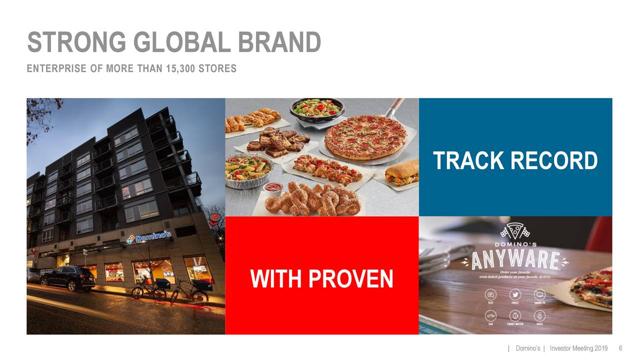
Thursday, March 14, 2019

Investors Sell Visa (V) on Strength (V)

Traders sold shares of Visa Inc (NYSE:V) on strength during trading hours on Tuesday. $197.61 million flowed into the stock on the tick-up and $383.27 million flowed out of the stock on the tick-down, for a money net flow of $185.66 million out of the stock. Of all equities tracked, Visa had the 5th highest net out-flow for the day. Visa traded up $1.06 for the day and closed at $151.73

A number of research analysts have recently commented on the company. reaffirmed a “buy” rating on shares of Visa in a research report on Tuesday, February 12th. SunTrust Banks reiterated an “outperform” rating and set a $250.00 price objective on shares of Visa in a research note on Friday, February 1st. Raymond James reiterated an “outperform” rating and set a $152.00 price objective (down from $167.00) on shares of Visa in a research note on Thursday, January 31st. Cantor Fitzgerald reiterated a “buy” rating and set a $160.00 price objective on shares of Visa in a research note on Thursday, January 31st. Finally, Jefferies Financial Group began coverage on Visa in a research note on Monday, January 28th. They set a “buy” rating and a $135.99 price objective on the stock. One analyst has rated the stock with a hold rating and twenty-eight have issued a buy rating to the company. The stock has a consensus rating of “Buy” and an average price target of $162.77.

Get Visa alerts:

The company has a debt-to-equity ratio of 0.58, a current ratio of 1.50 and a quick ratio of 1.50. The stock has a market cap of $302.45 billion, a P/E ratio of 32.91, a PEG ratio of 1.66 and a beta of 0.97.

Visa (NYSE:V) last announced its quarterly earnings data on Wednesday, January 30th. The credit-card processor reported $1.30 EPS for the quarter, beating the consensus estimate of $1.25 by $0.05. The firm had revenue of $5.51 billion for the quarter, compared to analyst estimates of $5.41 billion. Visa had a return on equity of 39.32% and a net margin of 50.61%. The company’s revenue was up 13.2% on a year-over-year basis. During the same period in the prior year, the company earned $1.08 EPS. As a group, equities analysts expect that Visa Inc will post 5.32 EPS for the current year.

The company also recently disclosed a quarterly dividend, which was paid on Tuesday, March 5th. Stockholders of record on Friday, February 15th were given a dividend of $0.25 per share. The ex-dividend date of this dividend was Thursday, February 14th. This represents a $1.00 annualized dividend and a dividend yield of 0.66%. Visa’s dividend payout ratio (DPR) is presently 21.69%.

In other news, Vice Chairman Ellen Richey sold 81,005 shares of the stock in a transaction dated Thursday, February 7th. The stock was sold at an average price of $139.99, for a total transaction of $11,339,889.95. The sale was disclosed in a document filed with the SEC, which is available through the SEC website. 0.17% of the stock is currently owned by corporate insiders.

A number of hedge funds have recently modified their holdings of the stock. Vanguard Group Inc. boosted its holdings in Visa by 0.5% during the 3rd quarter. Vanguard Group Inc. now owns 133,049,441 shares of the credit-card processor’s stock valued at $19,969,390,000 after acquiring an additional 640,593 shares during the period. Vanguard Group Inc lifted its holdings in Visa by 0.5% in the 3rd quarter. Vanguard Group Inc now owns 133,049,441 shares of the credit-card processor’s stock worth $19,969,390,000 after buying an additional 640,593 shares during the period. BlackRock Inc. lifted its holdings in Visa by 0.8% in the 3rd quarter. BlackRock Inc. now owns 122,485,390 shares of the credit-card processor’s stock worth $18,383,832,000 after buying an additional 936,305 shares during the period. FMR LLC lifted its holdings in Visa by 4.1% in the 4th quarter. FMR LLC now owns 90,524,036 shares of the credit-card processor’s stock worth $11,943,741,000 after buying an additional 3,606,814 shares during the period. Finally, Oregon Public Employees Retirement Fund lifted its holdings in Visa by 11,319.8% in the 4th quarter. Oregon Public Employees Retirement Fund now owns 86,570,056 shares of the credit-card processor’s stock worth $656,000 after buying an additional 85,811,983 shares during the period. Institutional investors own 80.00% of the company’s stock.

COPYRIGHT VIOLATION NOTICE: This article was reported by Ticker Report and is owned by of Ticker Report. If you are viewing this article on another website, it was stolen and republished in violation of U.S. & international copyright & trademark legislation. The legal version of this article can be accessed at https://www.tickerreport.com/banking-finance/4216562/investors-sell-visa-v-on-strength-v.html.

Visa Company Profile (NYSE:V)

Visa Inc operates as a payments technology company worldwide. The company facilitates commerce through the transfer of value and information among consumers, merchants, financial institutions, businesses, strategic partners, and government entities. It operates VisaNet, a processing network that enables authorization, clearing, and settlement of payment transactions; and offers fraud protection for account holders and assured payment for merchants.

Recommended Story: Trading Strategy Examples and Plans